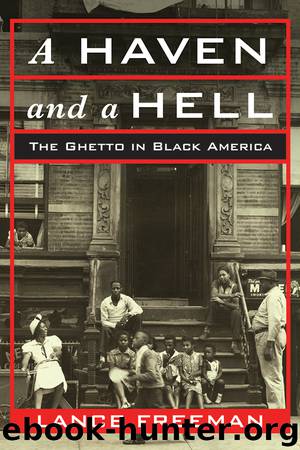
A Haven and a Hell by Lance Freeman
Author:Lance Freeman
Language: eng
Format: epub
Publisher: Columbia University Press
The Honorable Elijah Muhammad teaches us that on our own land we can set up farms, factories, businesses. We can establish our own government and become an independent nation. And once we become separated from the jurisdiction of this white nation, we can then enter into trade and commerce for ourselves with other independent nations. This is the only solution. The Honorable Elijah Muhammad says that in our own land we can establish our own agricultural system. We can grow food to feed our own people. We can raise cattle and use the hides, the leather, and the wool to clothe our people. We can dig the clay from the earth and make bricks to build homes for our people. We can turn the trees into lumber and furnish the homes for our own people.105
Or as Talmadge Anderson put it, “If black people are to be liberated under capitalism … black people must control the land and the institutions affecting the black community. In order to achieve this objective, it might mean the temporary, but strategic separation on an economic basis.”106
As an alternative to or in conjunction with autarky, community nationalism might mean a rejection of capitalism altogether. Black power in this view meant “the primitive accumulation of capital by black people in a collective or co-operative ownership fashion for the benefit of the masses of black people and not just a few individuals.”107 Or community nationalism might mean practicing the principal of Ujaama, or cooperative economics. Ujaama is one of the seven principles of Kwanzaa, which was conceived in 1966 by the US organization. Ujaama stresses a cooperative and communal economy that will prevent individuals or groups from amassing undue wealth and power or from experiencing extreme poverty. As distinguished from “European communism,” the collective approach practiced by blacks was to be “voluntary” and thus “communal.”108
Whatever emotional appeal autarky or communal socialism may have had, neither idea came to fruition. Autarky would have required blacks to form a self-contained economy, which, of course, would have been impractical even if the majority of blacks had desired to do so. Moreover, for the same reason that economic isolation makes nations poorer, autarky would likely have made blacks poorer. Economic growth typically occurs from economic specialization that allows a region or group to use trade to its advantage. Autarky would have required blacks to provide all goods and services in their self-contained economy. Most likely, blacks would have had to do without goods and services or pay much higher prices for these items. “Model minorities” that are typically held up as economic success stories typically achieve such success by specializing in a particular “ethnic niche.”109 Communities that have attempted to practice a limited form of autarky (e.g., the Amish) are typically not known for their economic dynamism. Likewise, communal socialism would be impractical to implement in the midst of the largest and most developed capitalist nation on earth and, based on the experiences of other socialist nations, would likely have increased economic inequality between blacks and whites.
Download
This site does not store any files on its server. We only index and link to content provided by other sites. Please contact the content providers to delete copyright contents if any and email us, we'll remove relevant links or contents immediately.
| African-American Studies | Asian American Studies |
| Disabled | Ethnic Studies |
| Hispanic American Studies | LGBT |
| Minority Studies | Native American Studies |
Cecilia; Or, Memoirs of an Heiress — Volume 1 by Fanny Burney(32558)
The Great Music City by Andrea Baker(32019)
Cecilia; Or, Memoirs of an Heiress — Volume 2 by Fanny Burney(31956)
Cecilia; Or, Memoirs of an Heiress — Volume 3 by Fanny Burney(31942)
We're Going to Need More Wine by Gabrielle Union(19046)
All the Missing Girls by Megan Miranda(16029)
Pimp by Iceberg Slim(14508)
For the Love of Europe by Rick Steves(14121)
Bombshells: Glamour Girls of a Lifetime by Sullivan Steve(14076)
Talking to Strangers by Malcolm Gladwell(13370)
Norse Mythology by Gaiman Neil(13366)
Fifty Shades Freed by E L James(13242)
Mindhunter: Inside the FBI's Elite Serial Crime Unit by John E. Douglas & Mark Olshaker(9343)
Crazy Rich Asians by Kevin Kwan(9292)
The Lost Art of Listening by Michael P. Nichols(7506)
Enlightenment Now: The Case for Reason, Science, Humanism, and Progress by Steven Pinker(7314)
The Four Agreements by Don Miguel Ruiz(6765)
Bad Blood by John Carreyrou(6622)
Weapons of Math Destruction by Cathy O'Neil(6281)
